Cleaning products trigger capping
For disinfectants, surface cleaners, degreasers and other trigger-spray home-care bottles. Key factors include cap orientation, chemical compatibility and bottle stability.

Applications
Use these application routes to shortlist the correct trigger capper, pump capper or screw capping machine for your products.
For disinfectants, surface cleaners, degreasers and other trigger-spray home-care bottles. Key factors include cap orientation, chemical compatibility and bottle stability.
For mists, sprays, lotions and pump closures where presentation, repeatability and clean handling are important.
For robust bottles with trigger, pump or screw closures, where line integration and safe handling matter.
For multi-SKU operations where quick changeovers, configurable guides and flexible cap presentation are essential.
For smaller bottles where compact screw capping or semi automatic capping can be the most practical route.
For filling, capping, labelling, coding and conveyor integration where several stages must work together.
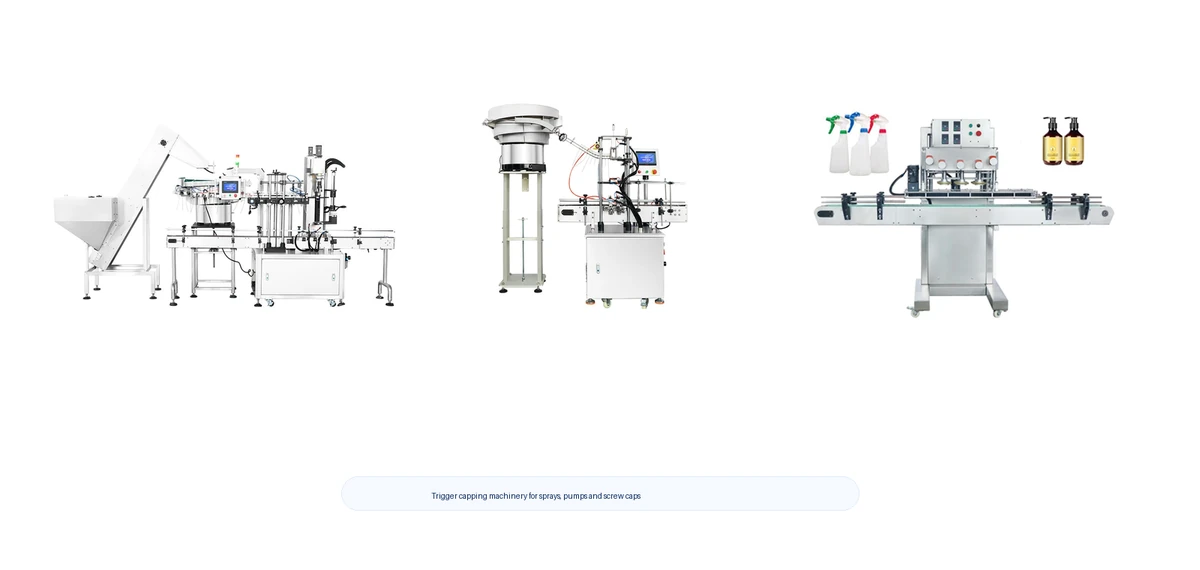
Project fit
For trigger-spray projects, the closure often dictates the machine more than the product itself. For screw and pump caps, torque, bottle stability and cap feed consistency usually decide the correct route.
Dedicated application pages
Use these pages when product type or bottle format is the fastest way to specify the capping machine.
Spray bottle capping machine options for trigger sprayers, pump closures and screw caps. Compare semi-automatic and automatic capping routes.
Capping machines for cleaning products, disinfectants and home-care trigger spray bottles. Plan trigger cappers, pump cappers and line integration.
Chemical bottle capping machines for trigger sprays, pump closures and screw caps. Compare machine routes, material compatibility and integration support.
Pump capping machine options for pump bottles, trigger sprayers and screw closures. Compare torque control, cap placement and line integration.
Application engineering
The sector name helps with context, but the machine is selected from the real bottle, trigger, dip tube, product weight, line speed and changeover plan.
| Application route | Typical engineering questions | Evidence to provide |
|---|---|---|
| Household and cleaning products | Does the filled bottle remain stable during tightening? Can residue reach the capper? Is a fixed trigger direction required for presentation or packing? | Filled bottles, closure samples, tube length, product description, cleaning method and target output. |
| Chemical and industrial sprays | Are wetted or exposed materials compatible with the product environment? Are spill containment, extraction or special guarding requirements defined? | Product safety information, bottle/closure material, site requirements and line layout. Final compliance scope must be agreed for the actual project. |
| Cosmetics and personal care | Must decorated closures remain free from marking? Is actuator direction controlled? Are frequent format changes expected? | Approved appearance samples, cap-height reference, torque requirement, SKU matrix and changeover target. |
| Contract packing | How wide is the bottle and closure range? Which formats share tooling? How will recipes, parts and first-off approval be controlled? | Complete format matrix, forecast batch sizes, changeover sequence, operator duties and acceptance criteria. |
| Garden and automotive sprays | Are bottles tall, lightweight or shaped? Do tubes curl after storage? Does secondary packing require a consistent trigger direction? | Production-age closures, filled-weight bottles, case/packing orientation and representative storage condition. |
Record material, overall height, body width, neck finish, shoulder shape, filled weight, centre of gravity and any panel flexibility that may affect guides or side belts.
Record cap diameter, cap height, thread, trigger body envelope, nozzle direction, tube length, tube material, tube curvature and the required final orientation.
Define how cross-threading, cap height, torque, tube damage, leakage, cosmetic marking and orientation will be inspected during trials and production.
Confirm upstream filling rate, bottle pitch, conveyor height, available accumulation, downstream labelling/coding, stop signals, utilities and operator access.
Application evidence
Household, chemical, cosmetic and contract-packing labels do not define machinery suitability on their own. The project still needs pack, product, line and quality evidence.
Bottle material, filled weight, neck finish, trigger geometry, dip-tube dimensions, component tolerances and required final orientation.
Product condition around the capper, drips or residue, bottle spacing, closure loading, accepted output and changeover frequency.
Utilities, access, cleaning method, line interfaces, quality release, safe intervention, training and support requirements.
Use the FAT and SAT checklist, quality inspection guide and safety and PUWER guide to turn those facts into an acceptance plan.
Application compatibility
Product sector alone does not define the capper. Cleaning, chemical, cosmetic and contract-packing applications should be reduced to measurable pack and process conditions that can be compared across the required formats.
| Application input | Why it matters to trigger capping | Evidence to provide |
|---|---|---|
| Product and fill condition | Filled weight, foaming, residue, drips or product compatibility can affect bottle support, cleanliness and inspection. | Representative filled samples or an agreed safe substitute, plus relevant handling information. |
| Bottle family | Material, shape, shoulder, base, neck finish and wall stiffness affect guidance and resistance to tightening torque. | Production-intent bottles, drawings where available and the least stable format. |
| Trigger or pump family | Body geometry, nozzle direction, thread, dip tube and surface condition affect feeding, placement and tightening. | Normal production components from the intended supplier and packaging condition. |
| Format range | Several SKUs may need different tooling, settings, inspection or changeover procedures. | Complete format matrix and expected campaign or changeover pattern. |
| Line interfaces | Filling rate, conveyor pitch, accumulation, labelling orientation and reject handling affect the complete result. | Line layout, control states, available space and upstream/downstream duty. |
Use the trigger bottle and closure compatibility guide and the sample trial matrix to turn application data into testable machinery requirements.